Saturday, December 2, 2006

Go, Damien!

By chance, I wandered into a lovely leafy road on the way back from the famous cemetery in Buenos Aires. A British film crew was parked up on one side of the pavement and their photographer appeared to be shooting stills of a guy in a car with a German plate across the road. Next to him, in a make-shift tent, two of the crew were editing images on a large fancy Mac.


"Nice and soft, Damien," said a very English voice, as I walked by. As well as taking soft pictures, Damien was holding a branch of leaves in front of the camera, to make the shot look leafier than it was. Clever, huh?

Friday, December 1, 2006

A spot of lunch in Uruguay

I took the boat to Colonia del Sacrementa - Uruguay´s most westerly port and an hour´s rapide boat ride from Buenos Aires. The round trip costs $160 (about 30 pounds), so when you consider the number of steaks you could buy with that here (about 10) it´s not cheap, but it´s an adventure - a voyage. They even serve you complimentary snacks and drinks at your seat on the boat. And Uruguay´s in a different time-zone to Argentina, so you feel like you´ve really arrived somewhere.

Uruguay is a little triangle (or rectangle, depending on which map you look at) sandwiched between Argentina and Brazil and is famous for winning the first ever World Cup and Frey Bentos pies. The old meat factory is now a museum, but in its 1940s hay day it slaughtered up to 2,000 cattle a day. You may well have eaten part of one when you were younger. I have.

The most mortifying thing happened just after I walked into the town from the port. My camera died without any warning. Moments later, the most awesome photo opportunities jumped out at every corner, as if they knew I couldn´t get hold of them.

So I am going to have to describe Colonia myself.

Imagine the loveliest white-washed, single-storey town on a remote Greek island. Now paint half the buildings bright red, yellow, pink and blue. Leave the rest white. Some can be a bit crumbling or have exposed brick-work.

Take out all of the inhabitants, then put just a handful back. Let a few tourists in, say 10 a day, as long as they´re nice and quiet and spread out when they get there and leave promptly.

Plant lots of old leafy trees and let pretty flowering shrubs grow up and over every wall. Let the birds sing.

Cobble the streets and erect wooden tables and chairs at the corner of each, for these shall be the bars and cafes.

Then set the thermostat to around 25°C and fix the breeze low-to-medium.

Oh, and did I mention that it's completely surrounded by the sea?

I sat myself down outside the third restaurant I walked past and ordered a chivitos - which, according to the menu, was the national dish of Uruguay. In a rare moment of translation, the menu also declared, "All things that we have in our restaurant are for sale" and I wondered quite what they meant by this.

Anyway, chivitos. Chivitos is sirloin steak topped with bacon, cheese, a fried egg and peppers. The one I ordered arrived on top of a mound of chips and a dog-sized bed of shredded lettuce. Which in turn was surrounded by wedges of about three large tomatoes and a mixed salad of tinned peas, carrots and potatoes folded through mayonnaise. It was all so huge and pilesome that they give you an extra plate to decant it onto so that it doesn´t fall off into the sea while you eat it.

The steak was smallish and bashed out thinly. It was just cooked - juicy and with that faint-to-medium whiff of meat that´s been hanging around a bit, which is generally okay with beef, though not advisable with poultry. So I decanted the steak and toppings first and got through with relative ease to the underlying section.

The chips weren´t properly cooked - they were white and floppy - but I wasn´t really bothered about these, so I left them. I made a courageous stab at the lettuce and tinned salad. Although lettuce doesn´t taste of much and isn´t particularly filling, there´s only so much of it you can be bothered to eat in one sitting. After about half an hour, it looked like I´d barely made a dent in the whole dish and felt like a phoney fuss-pot pushing food around my plate, wishing it would disappear, or at least look like less. In the end they took it away from me.

It occured to me halfway through my lettuce attempt that I still hadn´t quite pinned down the exchange rate - Uruguay having a totally separate currency to Argentina, and rightly so - and prices on the menu were pretty scarey. The chivitos, for example, was $250. I´d read about the economic crisis in the 1960s and the country´s downfall after the foot-and-mouth disease ("the fight against which", posters at the port´s immigration tell you, "is everyone´s responsibility") and about how they were bailed out by the World Bank. I had only Argentinian dollars - 100 of them, about 20 quid - which I´d been told by other travellers was legal tender. But I stalled paying for a while and read my book for an hour or two. I could always pop to a cashpoint if need be. If there was one here.

The bill in the end topped out at 45 of my $100. Which would buy about five steak dinners in Argentina. A hell of a lot of dosh, really. I climbed to the top of the nearby lighthouse to get over it, then mid-afternoon I paid a staggering $24 for a coffee and water (now that´s more than London prices). Though, oddly, a huge early-evening beer was only $6. I put it down to a somewhat loose conversion system and would advise changing up into Uruguay´s own currency before you go there for lunch.
A rare photo of a bar in Colonia...

Thursday, November 30, 2006

Now that's what I call recycling

I started to notice a funny thing.
Every chef who works a grill here in Buenos Aires sharpens his knife everytime he uses it. Nothing unusual about that.
But it's what's on the end of the steel (la cyaira) that caught my attention. See the yellow stuff that looks like a bit of ropey old soap?
It's dried beef fat.
They put it on there so the knife doesn't slip and cut their hand off when they're sharpening it. As the fat dries, it hardens and works in the same way as a cross-guard on a sword. (I just looked that up in an armoury glossary.) After all, it's pretty hot working on a grill - hands get sweaty and it's all pretty hectic and fast. Knives can slip.
Sometimes the simplest things are the best. All the chefs do it.
So the next time you trim the fat off your steak before you fry it, remember those chefs in Buenos Aires as you throw it away.


And here it is from the other side.

Diego´s bar

More bottles than you could throw a coconut at


There's a nice old bar right next-door the hostel where I'm staying in San Telmo. It's run by Diego.
Here he is standing in front of dusty old Cinzano and Campari bottles. Check out that till.

In the background Billy Idol sings Hot in the City (he was right) and it's a good place to cool down with a beer in the evening.


Though I normally come here for breakfast.

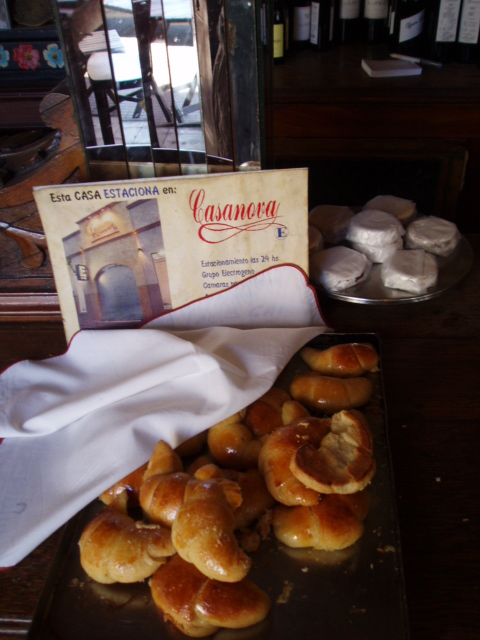
The coffee´s not the best in the world - it´s not particularly strong and sometimes they over-heat the milk - but the pastries more than make up for it.

They bring out flat metal trays packed with croissants, warm from the oven.

The cloths keep the flies off.

Well, kinda.


Best not to think about it really.


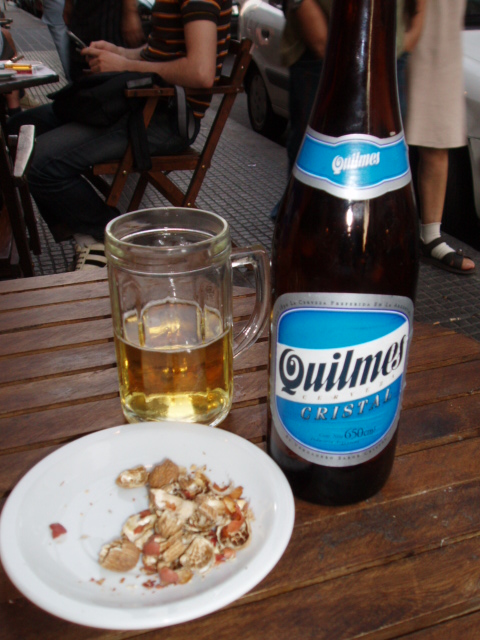
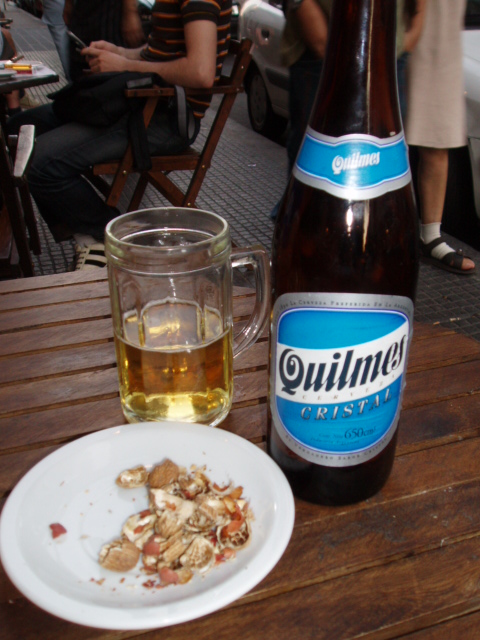
Everyone in Buenos Aires drinks Quilmes lager and if you order
one in Diego´s bar it always comes with a plate of monkey nuts.

Which you have no intention of finishing... but do.

Everyone here is super friendly.

Just don't expect to be served the moment you sit down.

Wednesday, November 29, 2006

Cream with that?

Ask for a cafe crema in Argentina and you'll get just that. Coffee with whipped cream. Not hot milk, like in France.

Most coffees in BA come with a glass of sparkling water. Apparently it´s good for digestion.

This coffee cost $4 - that´s about 90p. Quite pricey. But that´s because it was in Palermo, BA´s smart, leafy part of town. Think NYC crossed with LA.

There´s even a poodle parlour!

And clothes shops called things like Prototype and Chenson in mini malls.

Steaks are almost double the money you´d pay in San Telmo (of which more later) and you get the feeling that you wouldn´t be granted a photo opp behind the grill. Most kitchens are out of sight anyway.

It´s worth a visit though.

Tuesday, November 28, 2006

Say Steak


When a chunky Argentinian chef with a large knife puts his arm around you in front of a hot grill, it´s best to go along with it and smile. Even if you´re a bit scared.

The first meal... steak, what else?


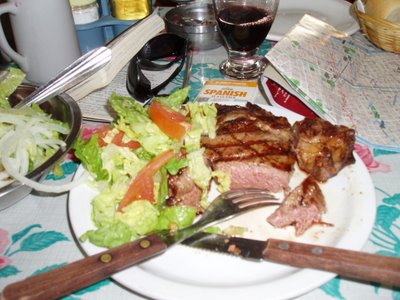
There´s nothing like a 12-hour flight stuffed with pappy bread, orange concentrate, month-old muffins and corner yogurts to make you crave food worth chewing - or just anything chewable even if it´s not essentially edible. And there´s times when only a fat, juicy steak will do. Especially when you´re in Argentina and know you´re surrounded by several tonnes of the stuff. Your teeth and gums are crying out for it. And once your taste buds get a whiff of it, then there´s no going back.

I´d already had it on good authority (my brother) that the best steak to be had in Buenos Aires is at a joint called Bar 6 in Palermo – and, of course, I will go there in time. But I wanted a local recommendation, so I asked Lara on the front desk of Hostel Carlos Gardel where I´d checked in for the five nights I´m here. “For steak, “ she declared, “you go to El Desnivel”. Two blocks down and two across. So I did. And I couldn´t walk fast enough. The air was thick with steaks frying, everyone was either eating or cooking the damn stuff. My mouth was starting to hurt.

El Desnivel is dead ordinary and laid back. Plastic-coated table cloths, yellowing plastic cruets, wicker baskets of bread, jars of pickles on the counter, flags draped over banisters. Bad music blares from under a table. Pretty make-shift and buzzing with city work types, the odd couple, the odd guy on his own. All shapes and sizes. As for the kit - imagine the the largest stainless steel chimney-style extractor fan then stick it above the biggest BBQ you´d ever find (probably in Tenessee) – and you got a grill. The bar on the other side is heaving with bottles of just about every alcohol ever invented.

I order the Bife de Chorizo – that´s a T-bone. The wait after ordering is pretty torturous. Smells become more intense, plates of chips piled with dark, dark meat sail by under my nose, and the whole time I´m picking at this pappy aeroplane bread that I can´t even taste, but it´s keeping me from chewing my pen to pieces.

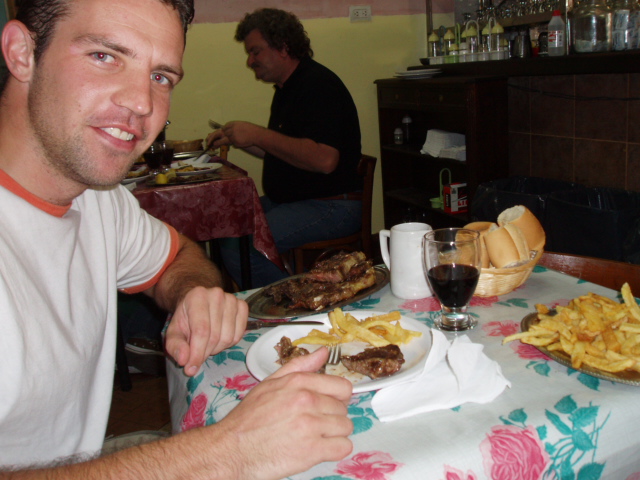
The house wine arrives in a milk jug and I get talking to the French guy on the next table. The steak arrives. It´s big, fat, marbelled, juicy and tender with a good bite. Tastes pretty good, too. Just about every bit is edible. It´s medium not rare (I wasn´t asked) but I don´t mind. French guy gives me some of his chips. Good crunchy contrast – more appealing than lettuce that´s for sure (note to self).. And the wine´s just right, too. It takes me ages to eat it. The bill comes to 24 bucks with service. That´s around a fiver.


French fries with a Frenchie


This is Alexandre, the French guy whose chips I ate (see, he got loads). He´s 29 and from Versailles and is here on holiday for 6 weeks. Back home he fixes air-cons units. He normally gets an hour for lunch, though often takes up to two. But that´s normal in France. Of course, if there was an air-con emergency he´d be right onto it. He lives for his holidays. He´d like to have kids one day but right now there´s just so many places to see. Besides, his mate´s just got hitched and moved to Brazil, so that´s next year´s holiday taken care of.